An Extraordinary Undersea 'Banquet' for 200 Million Crabs
By Katherine Latham
Share:
When millions of porcelain crabs came together to feed, they formed an orderly queue – a remarkable behaviour never seen before.
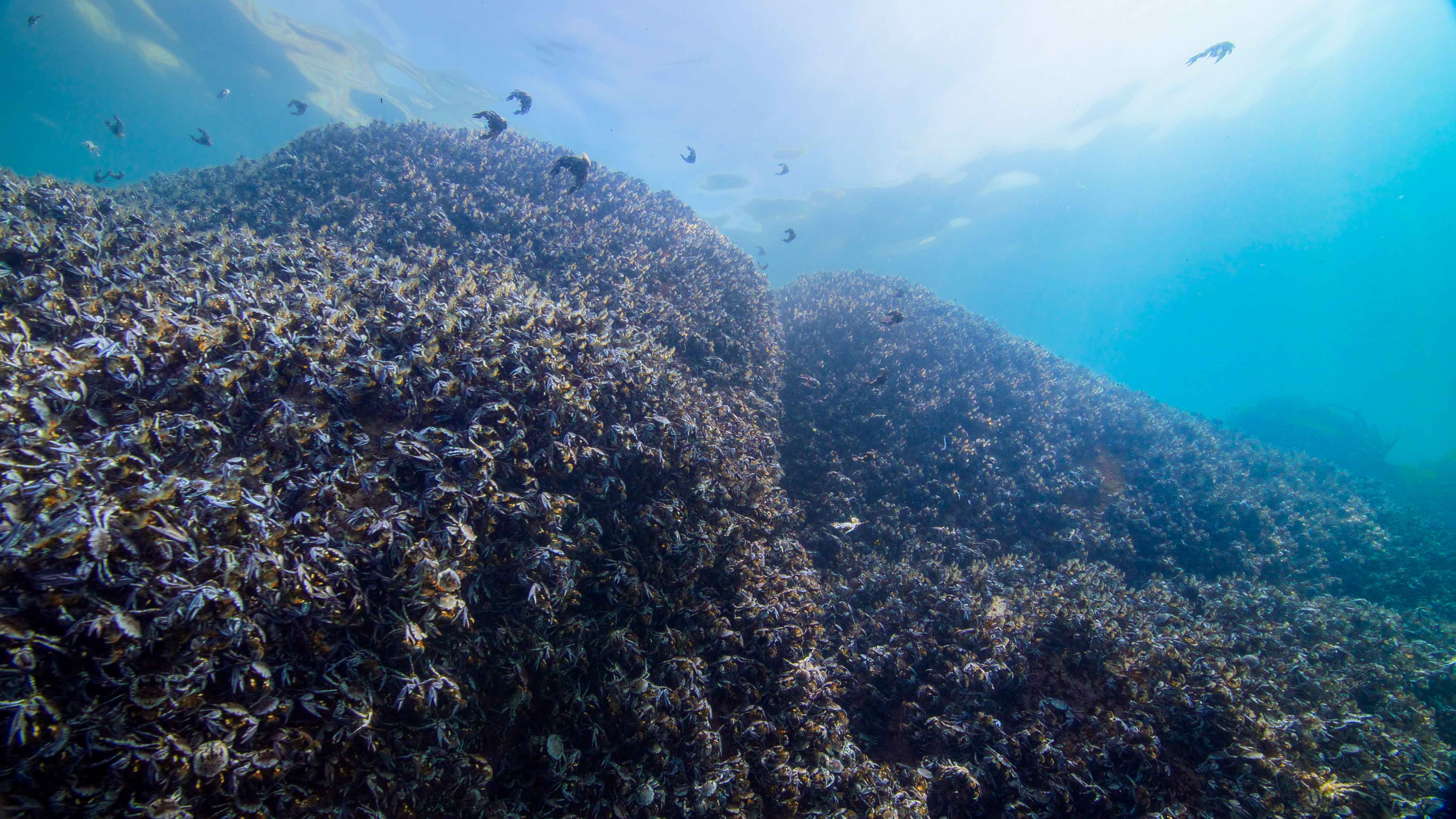
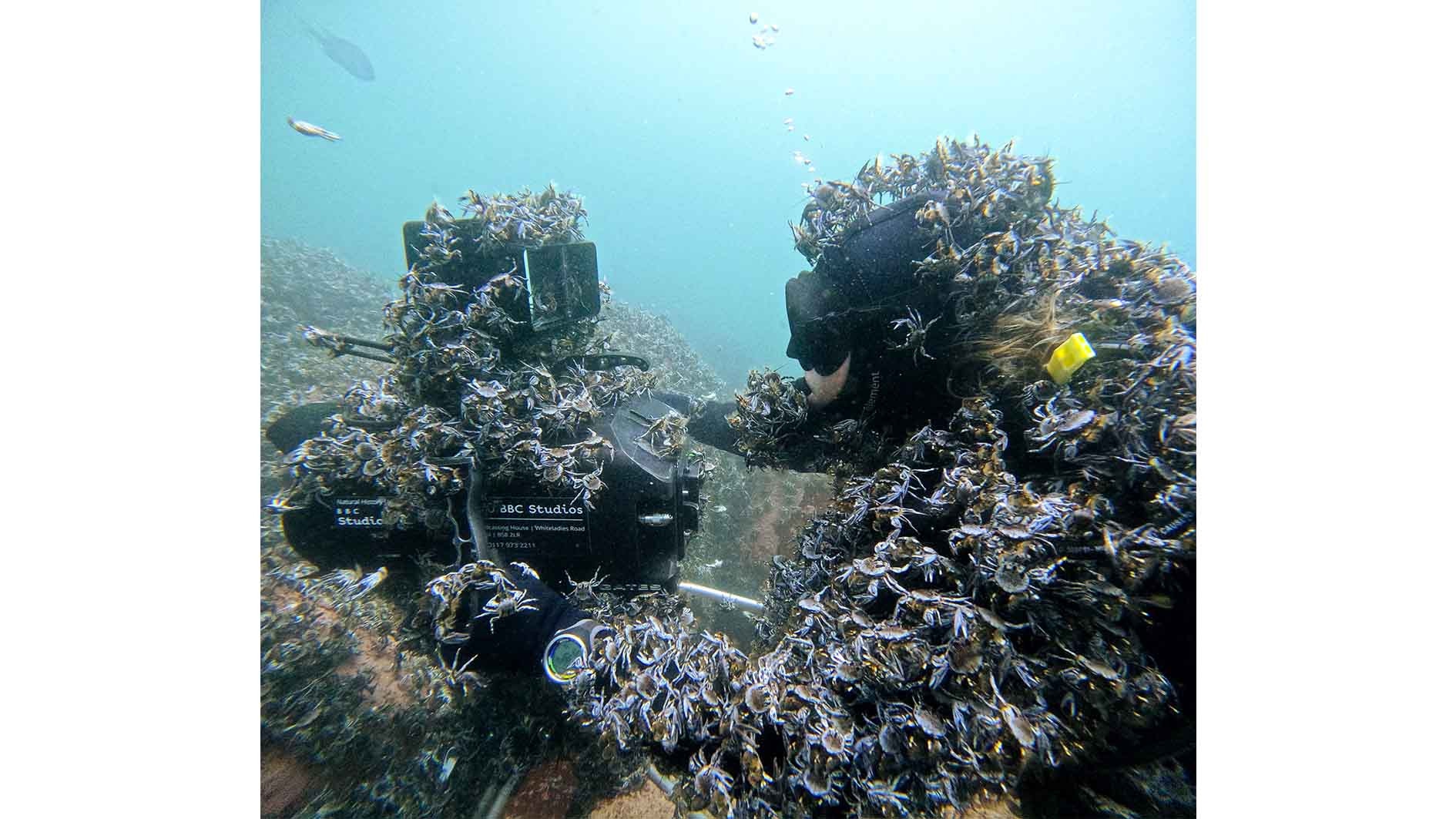
Is that a rock on the ocean floor, teeming with crabs? No, it’s a member of the Blue Planet III crew buried under a writhing mass of Chilean porcelain crabs.
"There were mountains of them – everywhere you looked – stretching off into the distance," says Joanna Haley, producer-director of the Blue Planet III episode, Seasonal Seas.
In the rocky shallows, near the Chilean fishing village of Caleta Chome, porcelain crabs gather in their millions to dine on the abundant nutrients welling up from the deep.
Sorry there is no content available for your region.
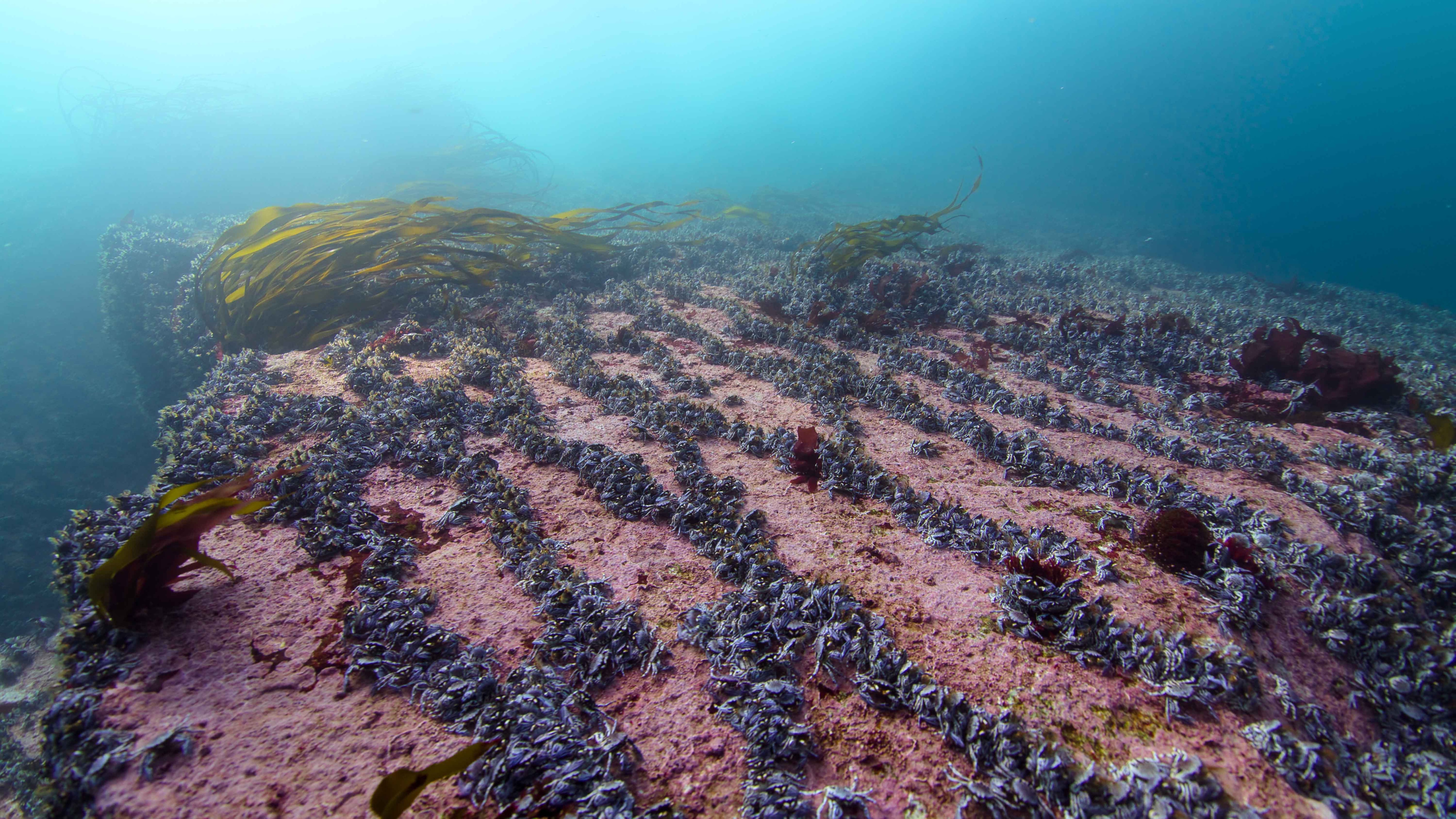
The Blue Planet III team captured this extraordinary event as around 200 million porcelain crabs gathered in what was one of the largest aggregations ever recorded. And not only was the size of the gathering unprecedented, but the crew witnessed something never seen before. The crabs organised themselves into lines to feed, a behaviour brand new to science.
When Haley and her film crew sank into the gloomy depths, a strong surge whipped trailing seaweeds violently back and forth, and threw the crew from side to side. Sediments stirred up from the seafloor, limiting visibility to just a few metres. "It’s a hard, hard filming environment," says Haley.
As they descended into the murky depths, a seething mass of millions of crabs appeared before their eyes.
They were there to film sea lions but when Haley heard about a huge number of crabs just a little way down the coast, she decided to go and check it out. "I was blown away by what we saw," she says. "It was just so crazy going under and seeing that for the first time. I was like, 'right, we need to film this'."
A wall of porcelain crabs (Allopetrolisthes punctatus), more than 200 million strong, try to feed and capitalise on a spring plankton bloom.
An ecological mystery
Porcelain crabs are named for their smooth porcelain-like shell and extreme fragility which allows them to voluntarily shed a claw or leg to escape the clutches of a predator. These are “false crabs”, having evolved a crab-like shape independently of true crabs, and are more closely related to squat lobsters and hermit crabs.
As babies, though, they look nothing like crabs at all. Freshly hatched porcelain crabs are tiny free-swimming larvae. After moulting their exoskeleton several times, they finally look like miniatures of their parents. Only then do they settle down on the ocean floor.
"Once a year, the community takes these crabs, boils them and makes a soup." - Ivan Hinojosa
"What kind of signals the larvae use to return, is an ecological mystery," says Ivan Hinojosa, associate professor at the Universidad Católica de la Santísima Concepción. It may be a combination of cues, he says. Chemical signals, sounds or even the Earth’s magnetic field may lead the larvae back to the place of their birth. The adults protect the juveniles by carrying them on their carapace or pincers, a sort of "foster" parental care, ensuring the survival of future generations.
Usually, porcelain crabs cluster under rocks or in reefs, hiding in the safety of crevices. This tactic offers them protection from predators. Living in high densities, however, comes at a cost.
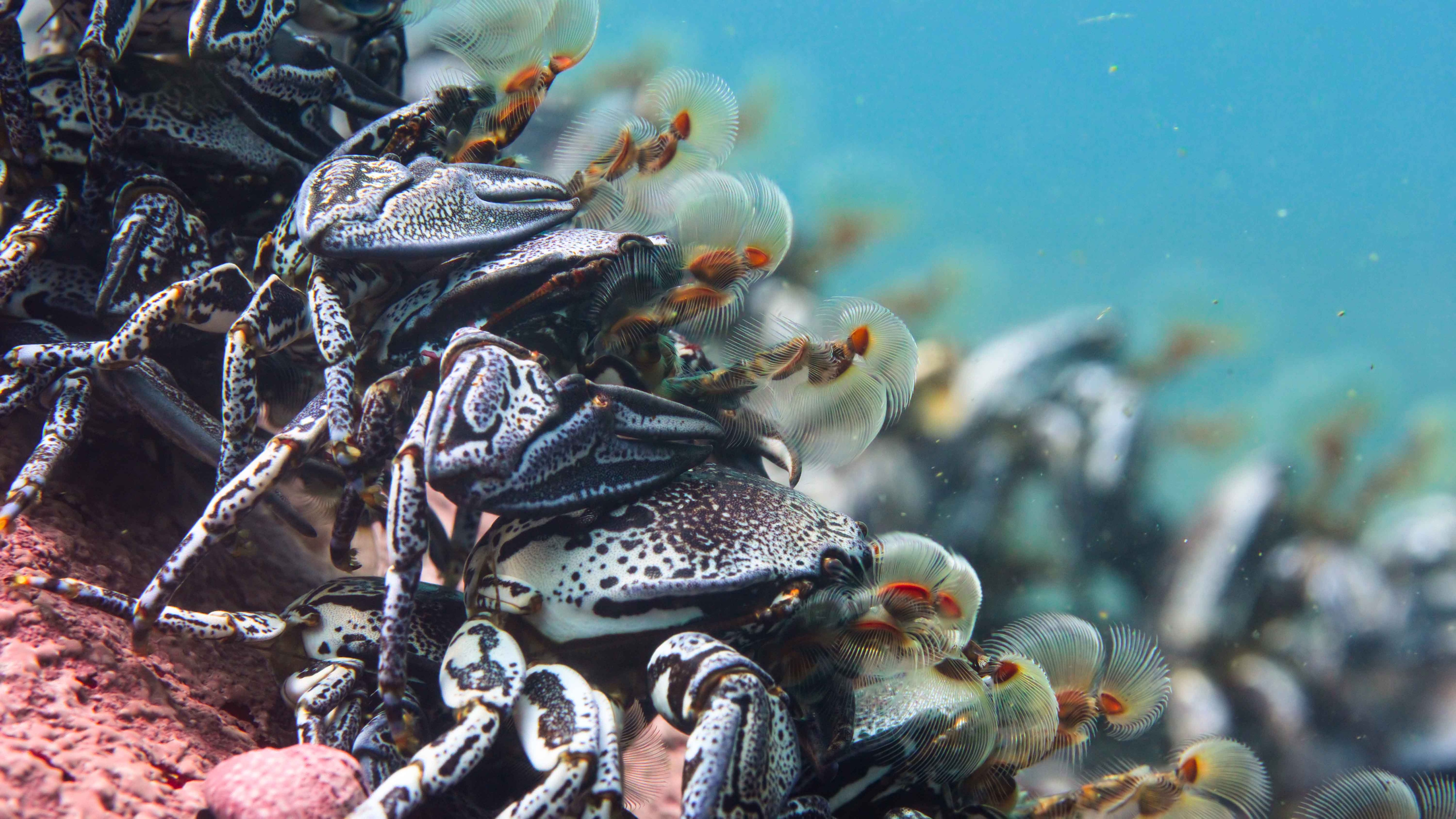
Porcelain crabs are filter feeders. They catch their food by waving feather-like appendages called maxillipeds through the water, capturing tiny particles that drift past on the current. In nutrient-rich waters food is abundant. The limiting factor for these crabs is not food but elbowroom. As the crabs jostle for the best spots to dine, and sufficient room to stretch out their feeding arms, smaller and younger crabs lose out to the larger adults in the crowd.
Chile’s porcelain crabs, known locally as "changai", have developed an ingenious solution to the problem of overcrowding. Changai don’t cower in the nooks and crannies but spill out onto the open ocean floor.
Other porcellanid species would never dream of occupying such treacherous territory and yet this brave little crab appears to be flourishing, their banquets growing ever larger.
Growing population: more nutrients and less predators could be reasons for surging porcelain crab numbers.
Back in the 1990s, says Hinojosa, these crabs were scarce. "In the northern part of Chile, [I saw] just one rock full of these crabs. I dove all along the Chilean coast and it was difficult to see them elsewhere. There was just this one rock. Then suddenly, they started appearing in different areas."
Now, fishermen of the Pacific coast of South America are reporting increasingly vast aggressions. Changai are not a fishery resource, says Hinojosa, but a pest. "They eat everything, all the larvae of other species. You are going to have very empty places, dominated only by these crabs. People here in Chile are worrying because it's going to have an impact on the fisheries."
However, changai do have a cultural significance, at least to the people of Concepción, says Hinojosa. "Once a year, the community takes these crabs, boils them and makes a soup. Maybe we can take that pest and transform it into a natural resource."
Why the population is flourishing is not fully understood. It may be due to a decrease in predators, suggests Hinojosa, or an increase in nutrients washed down from the rivers. "We are also looking at what is going on with the oxygen in the water column. You have huge concentrations in some places that have lower oxygen."
In recent years, Chile has seen an increase in the strength and persistence of upwelling, a consequence of climate change. Deep ocean water pushed up to the surface by winds is cold and low in dissolved oxygen. It is also rich in nutrients and triggers phytoplankton blooms at the surface. The phytoplankton eventually dies and decomposes, a process that consumes the oxygen further, leaving animals unable to breathe.
"It was so unexpected. Something we had no idea we were going to find just presented itself in front of us." – Joanna Haley
The porcelain crabs, though, are able to tolerate to this hypoxic environment, says Haley, which may explain why they have taken over in such an explosive manner – while other species struggle to survive.
"Plankton is such a huge driver of everything that's happening in the ocean," she says. "There’s no way you could make a Seasonal Seas film and not talk about plankton. But it’s such a hard sell. It was good to find something that could exemplify that part of the story of the seasons in such a visual way."
With over 1,000 crabs for every square metre of the seafloor, they clamber on top of each other forming hordes several layers deep.
Ocean ballet dancers
Not only do the changai aggregate in open spaces, but the crew were astounded to see these crabs – in their millions – organise themselves into lines before feeding in synchrony, waving their feathery limbs like little underwater ballet dancers.
"After days underwater, we realised that the crabs were making these line formations on the rock," says Haley. "It was so unexpected. Something we had no idea we were going to find just presented itself in front of us."
How hundreds of millions of crustaceans coordinate their actions like this is not known. Hinojosa suggests it may be that they are all vying for the ultimate spot to catch a meal as it passes on the current. Rather than working together, he says, "they are fighting for a better space. Each one is fighting for himself".
Dinner party: porcelain crabs organise themselves into lines to feed on ocean nutrients.
Steve Simpson, professor of marine biology and global change at the University of Bristol, suggests this queuing behaviour may trigger microcurrents which funnel the plankton between them, creating "a food superhighway".
"The crabs that join these aggregations proliferate," says Simpson, "so there's an evolutionary driver for this behaviour. Often simple rules in biology lead to really impressive collective behaviours. So, if your rule is get to the top and catch your food – what you end up with is this incredible array of crabs forming grooves and gullies."
The phenomenon is linked to the seasons, says Simpson. It happenswhen La Niña brings strong winds to the Chilean coast which, in turn, triggers upwelling events. This fuels very high levels of productivity, meaning the water is full of food. However, with the current record-breaking "super" El Niño, the upwelling is set to weaken. "It’s a good example of how, when we destabilise the climate, there can be large-scale implications for ocean productivity."
Animals that live in volatile inter- and sub-tidal habitats can tolerate a wide range of environmental conditions. This means they have more adaptive capacity to cope with the variability that climate change brings, says Simpson. "But this particular behaviour is finely tuned to the seasons, and we are seeing a decoupling of the timings – long-held adaptations that rely on certain things happening at certain times are becoming less successful."
As climate change accelerates, phenological mismatches are increasing in occurrence, leaving vital interactions in the natural world out of sync and species that depend on seasonal resources at risk.
"The crabs would see us as an extra bit of rock. Over the course of a dive, they'd slowly crawl onto us" – Joanna Haley
During dives, porcelain crabs would crawl onto crew while filming - BBC Studios / Amelia McCarten
A human banquet hall
By the end of each shoot, Haley and her crew found themselves covered from head to toe in changai. "The crabs would see us as an extra bit of rock. Over the course of a dive, they'd slowly crawl onto us."
Capturing the event in macro meant the crew had to keep as still as possible when filming. "Any little movements would be really obvious on camera," says Haley. "There was so little room down there, and the crabs were all fighting for space. You could hear them rustling as they tripped over each other. We suddenly became extra substrate for them to clamber onto to."
Their cameras and other equipment, too, became buried in crabs. Camera operator Bérénice Mathieu, says Haley, "would go into this sort of zen zone. She would be completely covered and it didn’t seem to bother her at all".
"It was one of those situations – when you’re on location and you see something that even scientists aren’t aware of" - Joanna Haley
Meanwhile, Haley was conscious of the crabs’ pointy little legs reaching under the mouthpart of her dive gear, tickling her lips, as she tried to concentrate on filming. "The crazy thing was, they started making the lines on our heads and feeding while on top of us," she says. As the crabs looked for any free surface space, the Blue Planet III film crew became a living banquet hall.
At the end of each dive, the crew had to gently "de-crab", says Haley, before returning to the boat.
"We came back with a sequence we hadn’t expected to film. It was one of those situations – when you’re on location and you see something that even scientists aren’t aware of. It was such an amazing spectacle. It was a real gift."