Venus, Mars, gas giants, frozen moons – there’s no shortage of unnerving places drifting around our Sun. Which is the worst?
Place a bar of lead on the surface of Venus and it will melt like butter. Not only is the temperature extreme – twice as hot as your oven – the pressure is equivalent to standing under nearly a kilometre (0.6 miles) of ocean.
“It’s pretty bad,” says Paul Byrne, a planetary scientist at Washington University in the US. “Venus is a particular kind of hell.”
Indeed, Professor Brian Cox, who hosted the BBC’s Solar System series in 2024, highlighted Venus as being particularly unnerving, saying it was “so horrendous… you would be squashed into a little pancake”.
Sorry there is no content available for your region.
As bad as Venus sounds, it’s just one of many terrifying places in our solar system: from icy moons with pitch black oceans to the radiation-laden orbits of the gas giants, you can take your pick of where to strike off your next holiday list.
Where else is on our list, and is Venus truly the worst? Let’s find out.
So horrendous… you would be squashed into a little pancake.
Radiation killer
One of the most terrifying places we’re on the cusp of learning more about is Jupiter, particularly some of its intriguing moons. Two missions, one from the US and one from Europe, are currently on their way to the Jovian system to return vital data to Earth.
Jupiter is the biggest planet in the solar system but also the deadliest. “It’s not only a massive planet, it’s got really interesting things happening within it that actually cause it to have an enormous magnetic field,” says Sara Webb, an astrophysicist at Swinburne University of Technology in Australia. Things like churning liquid metallic hydrogen and a rapid 10-hour rotation.
That immense magnetic field traps huge amounts of charged particles originating from some of its moons, the sun, and galactic cosmic rays in large radiation belts, which are lethal to passing spacecraft. “It’s like a physics wonderland,” says Webb, “but an absolute nightmare.”
Spacecraft we send to Jupiter can only spend minimal amounts of time close to the planet before their electrics are fried by the radiation, so they typically orbit the planet on wide swooping loops that only take them briefly into the belts. Both Nasa’s Europa Clipper spacecraft and ESA’s Juice mission will do this when they arrive at Jupiter in 2030 and 2031 respectively.
Another consequence is that some of the larger moons of Jupiter, which orbit quite close to the planet, are bathed in this radiation. One of these is Io, the most volcanically active place in the solar system, with more than 400 suspected active volcanoes. It is pushed and pulled by Jupiter’s gravity, churning its innards and sending plumes of magma launching above its surface.
“Io is just a hot mess,” says Gretchen Benedix, an astrogeologist at Curtin University in Australia. “It can go from way below zero to 1,600 degrees Celsius (2,900 degrees Fahrenheit) because of all the volcanic activity. It’s constantly resurfacing. It would be like living in a [volcano] as it’s erupting all the time, and [there’s] no air and no water.”
Byrne says there might be “crazy Io quakes” across its surface because it is in “this tug of war” with Jupiter, while its lack of atmosphere means there is nothing to stop debris from its many eruptions raining back down on the ground. Coupled with being deep in Jupiter’s magnetic field, “I don’t know how long it would take to kill you, but it wouldn’t be long,” says Byrne.
Any prospects of landing here in the future, whether that’s with humans or even just a robotic mission, would be exceedingly dicey – and downright scary.
I don’t know how long it would take to kill you, but it wouldn’t be long.
Eerie geysers
Farther out in the solar system we find Neptune and its intriguing moon Triton. The largest moon of Neptune, Triton orbits backwards around the planet relative to most of its other moons, suggesting it was a passing world captured by Neptune early in the solar system’s 4.6-billion-year history.
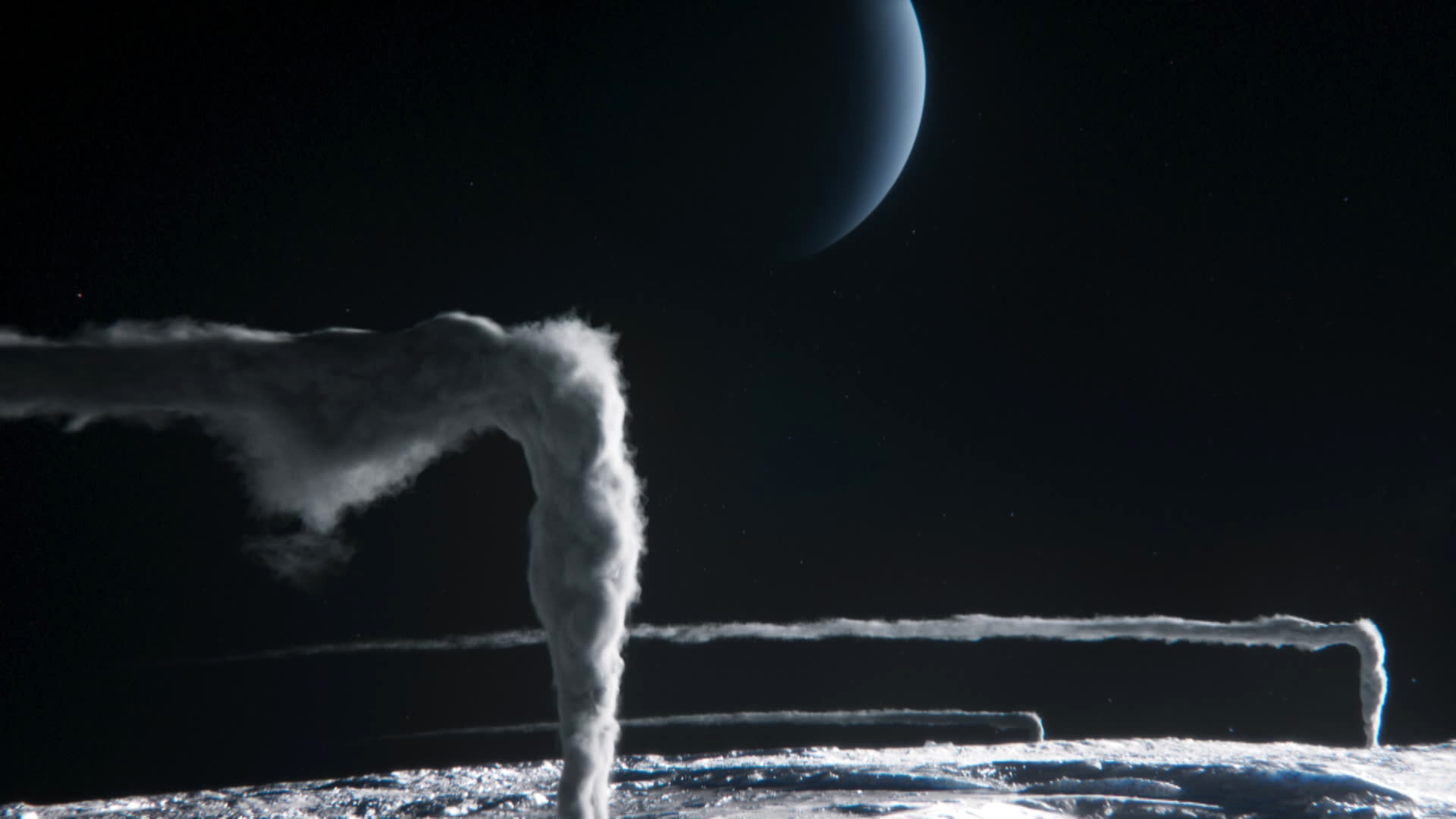
Triton has a thin atmosphere made mostly of nitrogen, fed by geysers that shoot out from its surface and reach heights of a few kilometres. “It’s this kind of frozen place with strange eruptions from the surface that rise up into space but then go flat because of this tenuous atmosphere,” Cox said previously.
The only spacecraft ever to visit Triton, NASA’s Voyager 2 mission in 1989, witnessed these geysers erupting but the cause of them is not entirely clear. It might be the result of a “glassy layer” of nitrogen ice that traps heat from the Sun, says Byrne, before pressure builds and pockets of gas explode upwards.
A geyser blasts high from the surface of Triton, Neptune's largest moon.
Like many other locations in the outer solar system, the surface would be eerie and cold, with temperatures dropping to -235 degrees Celsius (-391 degrees Fahrenheit). The Sun would be 30 times smaller in the sky than on Earth, giving the landscape a dim and muted feeling. If you were on the right side of the moon that faced towards Neptune, the ice giant would linger as a huge, watchful blue disk hanging in the sky.
Other locations in the outer solar system don’t fare much better, with temperatures plunging below -140 degrees Celsius (-220 degrees Fahrenheit) on all the hundreds of moons we know about, even Saturn’s moon Titan, which has a thick atmosphere and liquids on its surface akin to petroleum.
Some moons, such as Jupiter’s Europa and Saturn’s Enceladus, are also thought to have oceans trapped under their frozen surfaces, which might be terrifying to explore. There would be “no sunlight”, says Webb, leaving explorers trapped under kilometres of ice in “really thick, really dense water”.
Any of the worlds in the outer solar system could be classed as scary – barren, frozen expanses, or occasionally volatile and radiation-laden surfaces. For the scariest places however, we need to look closer to home into the inner solar system.
Under pressure
Venus is, by most accounts, the scariest place in the solar system. While the planet is a similar size to Earth and not too much closer to the Sun, something happened early in its life that caused it to experience a runaway greenhouse effect, developing a thick atmosphere that is almost entirely carbon dioxide today.
That leads to a world with an average surface temperature of 465 degrees Celsius (869 degrees Fahrenheit). “That’s hotter than an oven,” says Benedix. At that temperature, lead “melts like butter”, she says, while aluminium will “start to slide down and melt”. The clouds of Venus, meanwhile, are full of sulphuric acid and “not generally things you want to try to breathe in”, says Benedix.
For all its deadliness, Venus does have a surprisingly non-scary location. About 55 to 60 kilometres (35 to 37 miles) above its surface, there is a region of its atmosphere that is weirdly pleasant. Here, above the clouds, it is “the only other place in the solar system that is room temperature and [room] pressure”, says Byrne. “It would not be uncomfortable.”
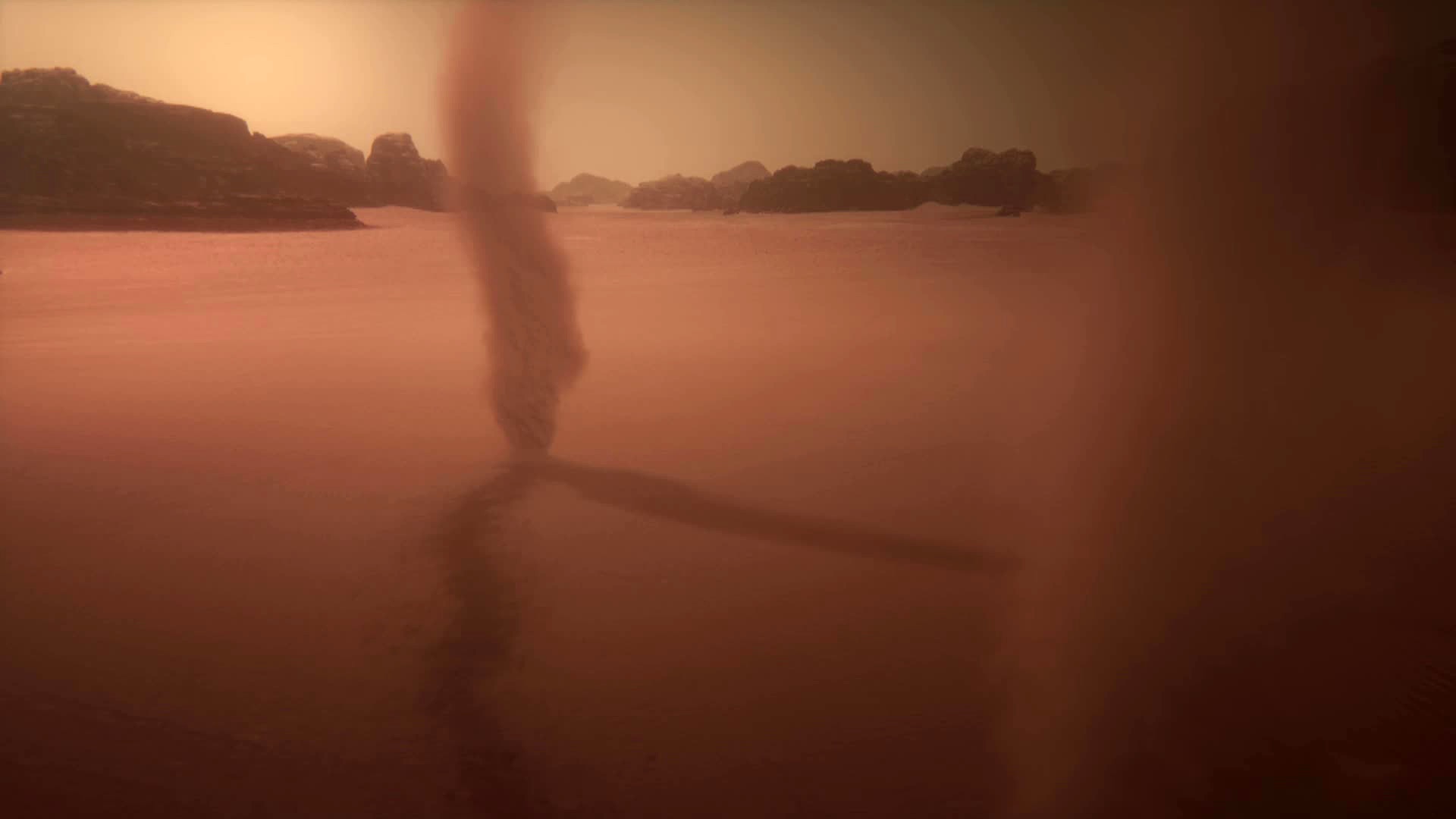
So perhaps we need to look elsewhere for the scariest place, and Mars is a pretty good bet. Not only does its surface temperature plunge to below -100 degrees Celsius (-148 degrees Fahrenheit) at night, it also has occasional dust storms that can blanket solar panels and limit visibility, as befell Mark Watney in the 2015 film The Martian – only the storms are nowhere the intensity of the fictional one that stranded Watney on Mars.
Sand storms rage in small tornadoes across the surface of Mars.
In terms of the other planets, however, Mars is probably “the least worst,” says Benedix. Maybe one of the worst places is actually much closer to home on our doorstep – the Moon.
Nasa’s Artemis II mission launched humans back to the Moon’s orbit for the first time in 54 years on 1 April, with both the US and China hoping to return humans to the surface by 2030. It makes sense – travel times to the Moon are about three days, compared to nine months for Mars.
But the Moon is deadly in its own right. Its surface, pummelled by impacts over its 4.5 billion years, is covered in shards of razor-sharp dust that could “shred your lungs if you get it inside you”, says Byrne.
Most of the Moon spends 14 days in permanent daylight before heading into 14 days of night. And perhaps worst of all, solar flares from the Sun can cause huge problems on the surface.
With no atmosphere, a powerful incoming flare could give a serious dose of radiation to any astronauts on the surface if they can’t get to shelter quickly enough. They would have just minutes of warning to get inside before extremely harmful particles arrived. “All the electrics go down and your communications go,” says Benedix. “You just lose it all.”
So perhaps the scariest place is the place we’re about to go back to. Or maybe it’s the deadly surface of Venus, or the eerie geysers of Triton. If you’re looking for frights, there are plenty of options to choose from.
“Almost every place in our solar system is unnerving and scary,” says Webb. “It’s a reminder just how incredible the universe is, that Earth is habitable for us.”